Technical Articles

Conditions for Fire Occurrence–Fire Triangle and Fire Tetrahedron

Fire occurrence depends on necessary and sufficient conditions, which this article explains. All fire protection measures aim to disrupt these conditions—removing fuel, limiting oxygen, cooling, or inhibiting chain reactions—enabling effective fire prevention and suppression.

Necessary conditions

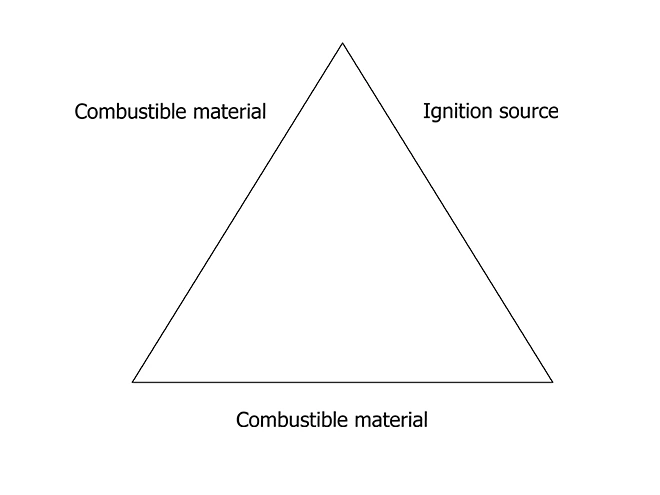
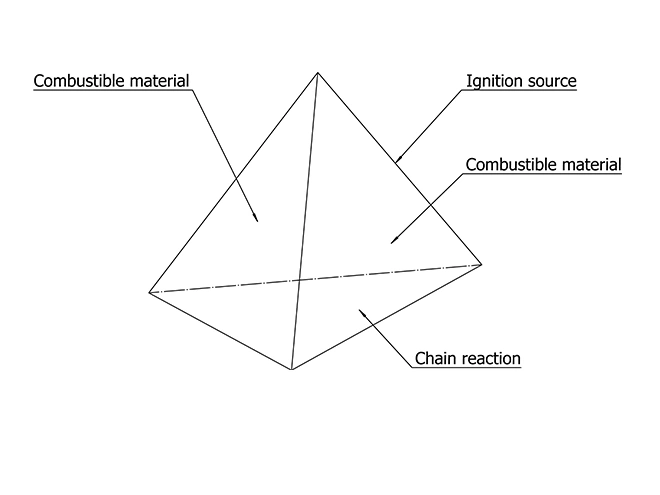
Combustion does not occur arbitrarily; it requires specific conditions. Fire ignition and development generally depend on three necessary elements: fuel, an oxidizer, and an ignition source. These are represented by the Fire Triangle for non-flaming combustion. For flaming combustion, an additional element—an uninhibited chain reaction—is required, forming the Fire Tetrahedron.

Fire triangle schematic diagram
Fire tetrahedron schematic diagram
Sufficient Conditions

Meeting the necessary conditions does not guarantee combustion. A quantitative threshold must also be met—this defines the sufficient conditions for ignition and sustained burning.

  • Adequate Fuel Concentration

    Fuel exists as solids, liquids, or gases. Flammable gases or vapors ignite only within specific concentration ranges. For example, hydrogen ignites/explodes in air at about 4% to 75%; below 4% or above 75%, combustion will not occur. Likewise, gasoline (below −38℃), kerosene (below 4℃), and methanol (below 7℃) cannot produce sufficient vapor; even with oxygen and an ignition source, combustion will not occur.

  • Sufficient Oxidizer Proportion

    Combustion requires enough oxidizer; otherwise it weakens or extinguishes. Tests show most combustibles cannot burn when oxygen content is below 16%. Therefore, a minimum oxygen concentration is required; below this threshold, combustion will not occur.The minimum oxygen concentration required for selected materials is shown in Table 1.

    Table1:Minimum Oxygen Concentration for Combustion (Selected Materials)
    Material Oxygen Concentration(%) Material Oxygen Concentration(%)
    gasoline 14.4 acetone 13.0
    kerosene 15.0 hydrogen 5.9
    ethanol 15.0 rubber dust 13.0
    ether 12.0 bulk cotton 8.0
    acetylene 3.7 candle wax 16.0
  • Adequate Ignition Energy

    Each fuel has a minimum ignition energy (MIE). Combustion occurs only when this threshold is met; otherwise it will not ignite. For example, gasoline has an MIE of about 0.2 mJ.

  • Uninhibited Chain Reaction

    For non-flaming combustion, the three conditions above are sufficient. For flaming combustion, an additional factor—free-radical chain reactions—must remain uninhibited to sustain burning, which is also a key sufficient condition.